
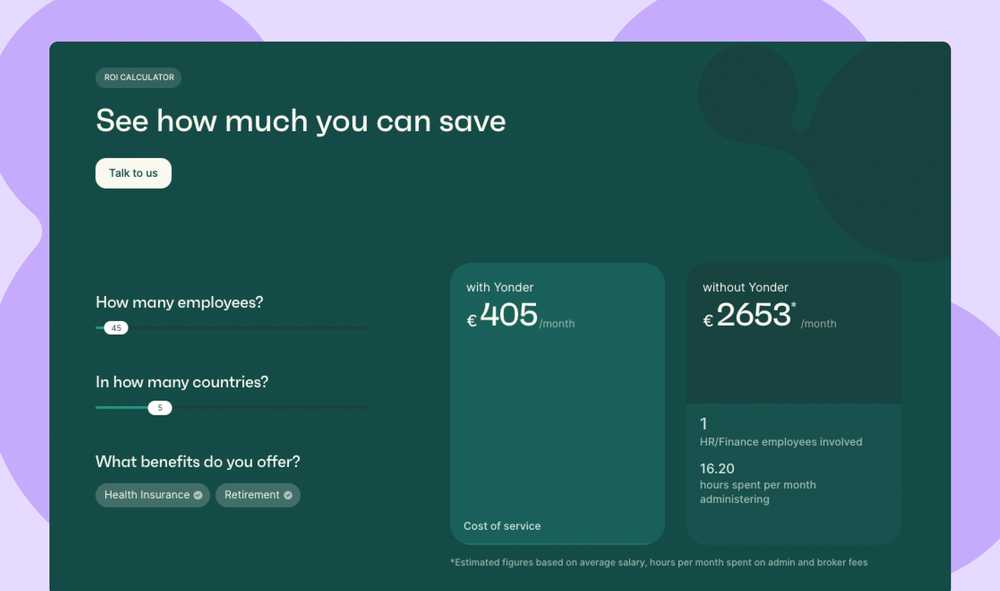
There's a large, quantifiable difference between scaling benefits traditionally vs running them on Yonder – we've built a return on investment tool to show you.
.webp)
.webp)
.png)
.png)
.png)
We speak to teams daily who are either looking to make the first step into offering their people benefits or scaling teams who are more distributed and trying to manage multiple providers in multiple markets. What comes with both is costs and administration – some of these are quite tangible while some of them are harder to see.
These costs come in direct costs, like people and finance ops administering benefits or paying brokers to administer certain parts, which can add up. But, also, the indirect costs of poorly executed benefits and coverage options for team members can be more of a seismic issue resulting in employee discontent and turnover. An example of this is speed – promising something to your team, and it takes months actually to make it available.
By removing the direct costs involved from what is the 'traditional' way of offering core benefits, there is more time to focus on the people and the outcomes desired.
We've been able to do this at Kota, which is a first for this industry, and cut the direct costs involved in offering core benefits like insurance and retirement, also while doing it in multiple regions. There's a primarily technical element to what we do to make this possible, but also a thesis and vision of what startups and growing companies need vs what they are selling traditionally.
We built Kota this way because it results in an unbelievably good user experience while removing all of those direct costs that have previously been levelled as table stakes in this industry. Well, they don't have to be.
Seeing is believing, but quantifying the impact on your bottom line helps too, so we've designed a tool to show you the effect of us vs the rest. Comparing the cost attributed to the people, the admin, the ops, and the brokers against our transparent €9 per active employee per month cost.

.png)
.png)
.svg)
.svg)
.svg)


.webp)
.webp)
.webp)
.webp)