Why we started Kota
In 2020 I was running Bolt in Ireland, and I wanted to set up a workplace pension for the team. I emailed a few brokers with what I thought were pretty basic questions, and each of them came back with reasons they'd need to charge us thousands of euro before they could even consider working with us.
To say I was confused would be an understatement. Was I paying the market rate? That was a consulting fee. Could we benchmark against companies our size? Another one. What was the split between what the company paid and what employees paid? An out-of-office saying they'd get back to me in four weeks. It felt like information about my own team, my budget and my decisions was being held hostage.
None of that was really the brokers' fault. They were working inside a setup that was never built to give anyone those answers quickly. The problem was the infrastructure sitting underneath benefits, and nobody seemed to be doing anything about it. I thought about how it could be fixed, and that's what eventually became Kota, which Patrick, Deepak and I started in 2022.
Today we're launching a new brand to mark the next chapter for Kota. It feels like the right moment to explain where we've come from and where we're heading.
Benefits used to be ambitious
It's easy to forget that benefits weren't always admin. More than a century ago, companies like Cadbury and Guinness met the demands of their employees and began housing their workers, paying for doctors and making sure pensions were passed on to families. Looking after your people was one of the boldest things an employer could do.
Over time, benefits became something every employer was expected to offer, and somewhere along the way they stopped being ambitious and turned into paperwork. In the last 20 years the rest of the HR stack, from payroll and HR systems to expenses and hiring, has moved to software that mostly just works, while benefits are still largely run on consultants and spreadsheets. Most People teams only really hear from their broker at renewal.
Two industries pretending to be one
The industry's answer over the last decade has been benefits platforms. They've made benefits look a lot better for employees, and that matters for the visual experience. But most of them sit on top of the old infrastructure without holding the policies, so behind the platform you still have the same email chains with brokers, the same back-office admin and the same scramble at renewal, which is the stressful bit most People teams were hoping a new platform would take off their plate.
What you end up with is two industries pretending to be one, with the software where companies manage their people on one side and the brokers and insurers who hold the cover on the other. When the two don't connect, someone in HR ends up being the connection. They email the broker when someone joins, check the invoice when someone leaves, and find out months later that a leaver is still covered. Nobody is accountable for that gap.
We hear some version of this every week. Hundreds of the companies we spoke to this year told us a fragmented setup was the reason they started looking for something new. Most of them already had some kind of benefits system in place, and they'd been let down when it didn't fix any of the problems underneath.
Rebuilding the infrastructure underneath benefits
We knew from the start that a better app wasn't going to fix this. What needed fixing was the infrastructure underneath: how policies get placed, and how they connect to everything else a company runs, from its HR system to payroll. When that works properly, someone joins in your HR system, their cover starts with the insurer and the deduction lands in payroll, and nobody in HR has to sit in the middle passing it along.
You can only do that if you're the broker, because the broker is the one placing the policies. That's why Kota has been a broker from day one. There was never a moment where we pivoted into it. It was always the problem, and we happened to be the ones who saw it.
So Kota is a broker and a benefits system in one. We hold your policies, connect them to your HR and payroll systems and pass changes straight to the insurer, which means a change made in Kota is a change made with the insurer. Employees can see every benefit they have in one place, and People teams can make changes themselves the same day, with our team on hand for the decisions that matter.
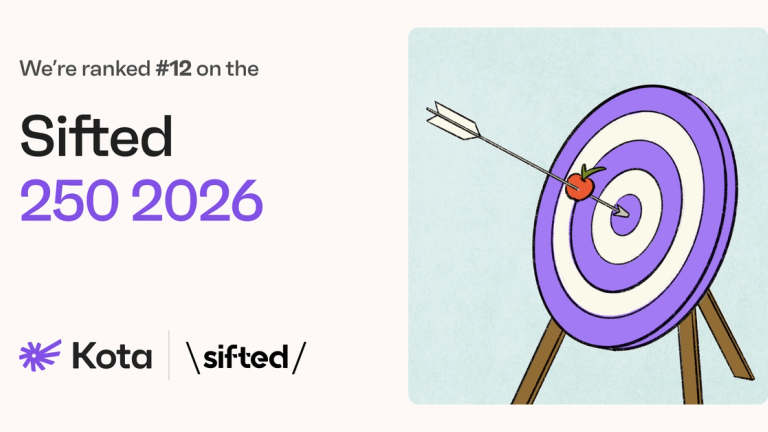
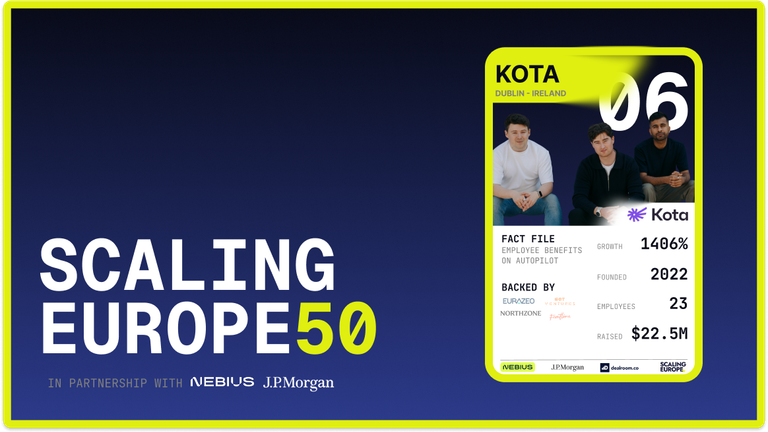
Today more than 85,000 employees get their benefits through us, whether their company came to us directly or through one of the HR platforms we power benefits for. This year Sifted ranked us the 12th fastest-growing company in Europe.
Behind the new brand
We'd outgrown our old brand - it reflected a young company starting to build a new way of offering and managing benefits.
The new brand shows what we've been building all along, which is the infrastructure underneath benefits, with us as the broker. A big thank you to Maksim, Dee, Barry and Laura, who managed to boil down what Kota is really about and turn it into something people get the moment they see it. And thank you to the rest of the Kota team, who built everything that sits underneath it.
The website we launched today puts it plainly: your broker and your benefits system, in one place. This is what makes everything else able to finally work.
What's next
With the infrastructure and the systems in place, we can start doing things with benefits that were never possible when everything lived in spreadsheets, inboxes, and disparate pieces of software.
There's something bigger we've been working on that sits on top of all of this. I'm not going to say much about it yet, other than that it changes how much work benefits take for People teams, and it makes a real difference to how employees experience their benefits day to day. More on that soon.
Benefits should be something People teams have the headspace to get creative with, a way to offer their people something that sets the company apart, rather than a box that gets ticked once a year at renewal. When the admin looks after itself, teams get that time back. They can think about what their people actually need, whether that's better support for new parents, cover that works for a team spread across countries, or a pension that means something to someone in their twenties, and put together a package that says something about the kind of company they are. We want Kota to make that possible again.
Thank you
To our customers, thank you for trusting us with something that matters this much to your people. To our partners, thanks for building this with us. And to everyone at Kota, I couldn't be prouder.
This is the next chapter, and I can't wait to get on with it.